
Understanding the Importance of Specialized ENT Billing
Managing the financial operations of an ENT practice requires accuracy, consistency, and deep knowledge of otolaryngology procedures. Billing for ENT services involves complex coding, strict compliance requirements, and high claim volumes, making it challenging for in-house teams to maintain efficiency.
Incomplete or inaccurate billing processes can lead to claim denials, delayed reimbursements, and revenue loss. A structured and specialized approach ensures that claims are submitted correctly and payments are received on time.
Why Specialized Billing Matters for ENT Practices
ENT practices perform a wide range of services, including diagnostic exams, allergy testing, sinus procedures, and reconstructive surgeries. Each service requires precise documentation and coding to meet payer requirements.
Generic billing approaches often miss these nuances. Specialized billing support ensures that:
-
Procedure-specific coding is accurate
-
Documentation aligns with payer expectations
-
Claims are submitted without errors
This improves approval rates and overall financial performance.
Understanding Complex ENT Coding Requirements
ENT billing requires detailed knowledge of CPT and ICD-10 codes. Procedures such as nasal endoscopy, tympanoplasty, and audiometry testing must be coded correctly to avoid denials.
Accurate coding ensures that:
-
Services are properly represented
-
Claims meet insurance guidelines
-
Reimbursements are not delayed
Staying updated with coding changes and payer policies is essential for maintaining compliance and maximizing revenue.
Efficient Revenue Cycle Management for ENT Practices
A well-managed revenue cycle ensures steady cash flow and financial stability. ENT billing services typically include:
-
Charge entry and claim submission
-
Payment posting and reconciliation
-
Denial management and appeals
-
Financial reporting and performance tracking
Efficient processes reduce errors, speed up reimbursements, and improve revenue consistency.
Compliance and Regulatory Requirements
ENT billing must comply with healthcare regulations such as HIPAA and payer-specific guidelines. Failure to meet these standards can result in audits, penalties, or claim rejections.
Maintaining compliance requires:
-
Accurate and complete documentation
-
Adherence to coding standards
-
Regular updates based on regulatory changes
A structured billing process helps reduce risk and ensures consistent compliance.
Benefits of Specialized Billing Support for ENT Practices
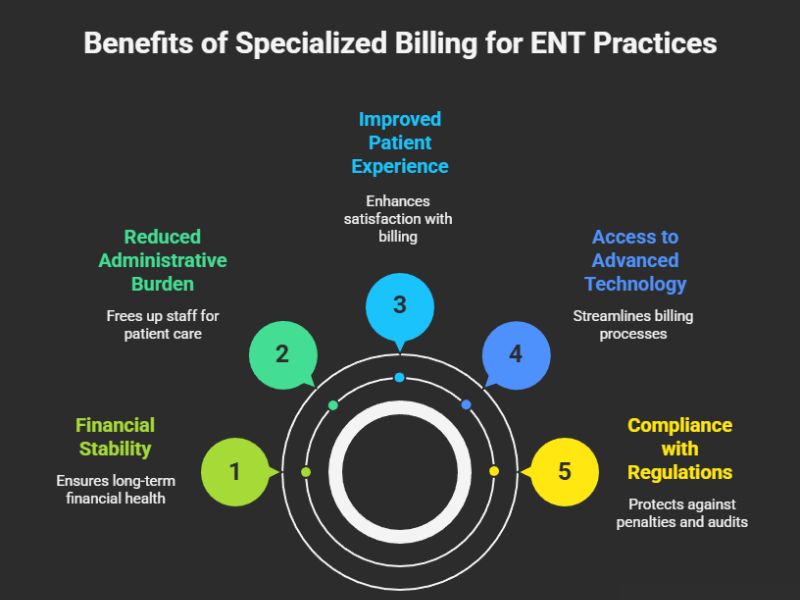
Reduced Administrative Workload
Outsourcing billing allows healthcare providers to focus more on patient care. Administrative tasks related to claims, coding, and follow-ups are handled by experienced professionals.
Improved Financial Performance
Accurate billing leads to:
-
Fewer claim denials
-
Faster reimbursements
-
Improved cash flow
Tracking key performance metrics such as denial rates and accounts receivable helps maintain financial stability.
Better Patient Experience
Clear and accurate billing improves transparency. Patients receive understandable statements and timely responses, which increases trust and satisfaction.
Access to Advanced Billing Technology
Specialized billing services use modern tools for:
-
Claims management
-
Coding accuracy
-
Electronic Medical Records (EMR) integration
This improves efficiency without requiring additional investment from the practice.
How to Improve ENT Billing Accuracy
Standardize Documentation
Use structured templates for procedures, diagnostics, and patient records to ensure consistency and completeness.
Optimize EMR Systems
Ensure seamless integration between clinical documentation and billing systems to reduce errors and improve workflow efficiency.
Train Staff on Coding and Compliance
Regular training helps staff stay updated with CPT, ICD-10, and payer requirements, reducing the risk of billing errors.
Conduct Regular Audits
Routine audits identify gaps in documentation and billing processes, allowing practices to improve accuracy and reduce denials.
Role of Medical Billing Services for ENT Practices in Florida
Healthcare providers looking for medical billing services in Florida can benefit from specialized support tailored to ENT practices. A professional billing partner helps ensure that all claims are accurate, compliant, and submitted on time.
With expert oversight, practices can:
-
Reduce billing errors
-
Improve reimbursement timelines
-
Maintain consistent revenue flow
-
Focus more on patient care
ProMD Medical Billing provides dedicated support designed specifically for ENT practices, helping streamline operations and improve financial outcomes.
Key Codes and Billing Considerations for ENT Practices
Accurate billing relies on proper coding and documentation. Commonly used codes include:
-
CPT 31231 for nasal endoscopy
-
CPT 69631 for tympanoplasty
-
CPT 92557 for comprehensive audiometry
-
ICD-10 codes for ear, nose, and throat conditions
Following payer guidelines and maintaining accurate documentation ensures successful claim processing.
Conclusion
ENT billing requires a detailed and specialized approach. Errors in coding, documentation, or compliance can lead to denied claims and revenue loss.
By implementing structured billing processes and ensuring accuracy at every stage, ENT practices can improve reimbursement rates, reduce administrative burden, and strengthen their financial performance.
Partnering with an experienced billing provider helps ensure that operations remain efficient, compliant, and focused on delivering quality patient care.
FAQs
1. Why is specialized billing important for ENT practices?
ENT procedures require precise coding and documentation. Specialized billing ensures accuracy, reduces denials, and improves reimbursement rates.
2. What are common billing challenges in ENT practices?
Common challenges include complex coding requirements, incomplete documentation, and frequent changes in payer guidelines.
3. How can ENT practices reduce claim denials?
Practices can reduce denials by standardizing documentation, verifying coding accuracy, and conducting regular audits.
4. What does revenue cycle management include for ENT practices?
Revenue cycle management includes claim submission, payment posting, denial management, and financial reporting to ensure consistent cash flow.